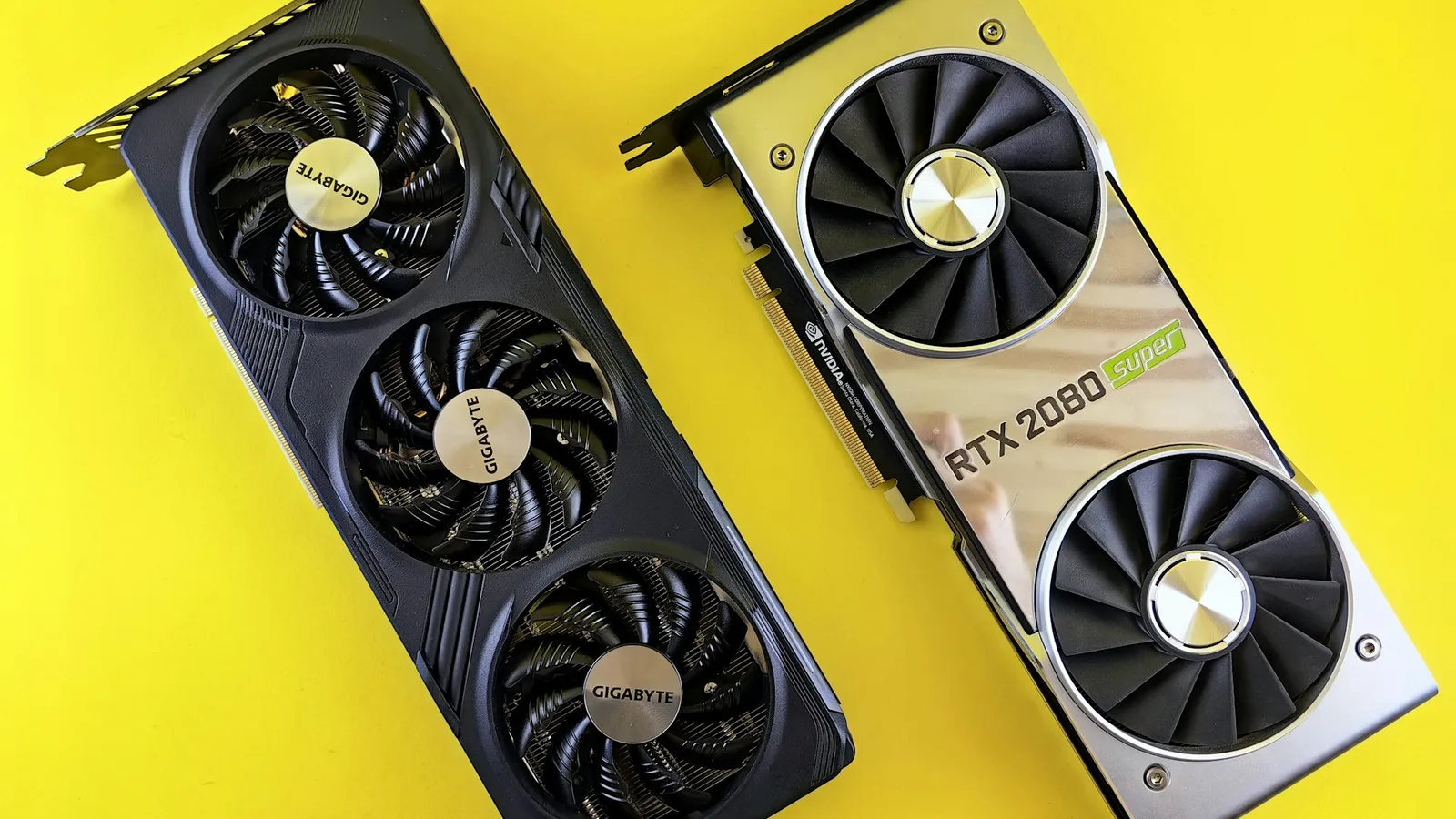

For rasterized gaming at 1440p, the RX 9070 is the better buy: it averages about 13% higher frame rates than the RTX 5070 in native rendering, carries 16GB of VRAM against the 5070's 12GB, draws less power, and costs only about $41 more in our catalog. Buy the RTX 5070 instead if you play heavy path-traced games, want the widest day-one upscaling support and Multi Frame Generation, or run creator apps that lean on CUDA and NVENC — because in those specific cases it pulls ahead of anything the 9070 can do.
Both cards launched in March 2025 at the same $549 MSRP, aimed squarely at each other (GamersNexus). That is why the matchup is confusing: on paper they share a price and a target resolution, so the spec sheet does not tell you which one to put in your build. The answer comes down to two questions — how much ray tracing you actually turn on, and whether 12GB of VRAM is enough for the games you play at the settings you play them.
Rasterized gaming: the RX 9070 leads at 1440p
In plain rasterized rendering — no ray tracing — the RX 9070 is the faster card at 1440p, and by a margin you can measure. Testing on a high-end CPU bench, GamersNexus recorded the 9070 at 172 FPS versus the 5070's 152 in Resident Evil 4 (Prioritize Graphics), and 96 FPS versus 83 in Starfield at Ultra — leads of about 13% and 15% (GamersNexus). Across a broad suite the average settles near 13% in the 9070's favor at 1440p.
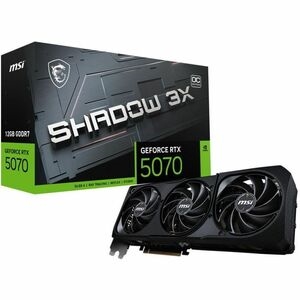
That lead is not universal, and the honest exception matters. Some engines favor NVIDIA hard — in Final Fantasy XIV: Dawntrail, GamersNexus found the 5070 about 21% ahead of the 9070 (GamersNexus). So "13% faster" is an average, not a promise for every title. If the specific games you play are the NVIDIA-leaning kind, the raster gap can shrink to nothing or flip. For most 1440p libraries, though, the 9070 is the card that puts more frames on screen.
Ray tracing: this is where the RTX 5070 earns its place
Turn on ray tracing and the story splits by how heavy the RT load is. In light and moderate implementations the 9070 keeps up: on Cyberpunk 2077's medium RT preset the two were effectively tied at roughly 81 FPS (GamersNexus). For the hybrid ray tracing most games ship, the 9070's RDNA 4 RT cores are good enough that you are not giving up much.
Full path tracing is a different sport. In Black Myth: Wukong at 4K with its heaviest RT settings, GamersNexus measured the RTX 5070 at 73 FPS against just 24 for the RX 9070 — the 5070 roughly triples it (GamersNexus). This is the core of the 5070's case. If your rotation includes path-traced titles — Cyberpunk's Overdrive mode, Wukong, Alan Wake 2 — NVIDIA's RT hardware is in a class the 9070 cannot reach at these settings. The honest caveat cuts both ways: even the 5070 needs upscaling and frame generation to make 4K path tracing smooth, so this win is real but conditional on how much of your library actually uses it.
Upscaling and features: FSR 4 finally competes, DLSS still reaches further
Upscaling is now part of how both cards are used, and here the two are closer than they used to be. FSR 4 is exclusive to RDNA 4 and therefore present on the 9070, and it was a genuine leap for AMD — reviewers credit it with closing most of the image-quality gap that made older FSR a liability. In TechSpot's testing, FSR 4 Quality delivered a 29% frame-rate uplift on the 9070 versus a 23% uplift from DLSS 4 Quality on the 5070 (TechSpot). Where FSR 4 is supported, the 9070 no longer trades away picture quality to gain frames.
The RTX 5070's edge is reach, not per-title quality. DLSS ships in far more games than FSR, it is likelier to be present on day one of a new release, and the RTX 50 series adds Multi Frame Generation, which the 9070 has no direct equivalent to. The catch for AMD is that FSR 4 only helps in titles that support it — older games fall back to worse FSR versions or none at all. If you buy new releases at launch and lean on upscaling to hit high refresh, that ecosystem breadth is a real, if situational, reason to choose the 5070.
VRAM and power: two quiet wins for the RX 9070
The RX 9070 carries 16GB of GDDR6 on a 256-bit bus; the RTX 5070 has 12GB of GDDR7 on a 192-bit bus. The 5070's memory is faster per gigabyte, but 12GB is already the tight number at 1440p when you max textures and enable ray tracing in the newest games — and RT itself consumes VRAM. The 9070's extra 4GB is the more future-proof position for a card you plan to keep a few years. If you are unsure how much you need, our guide to how much VRAM gaming actually requires walks through it by resolution and settings.
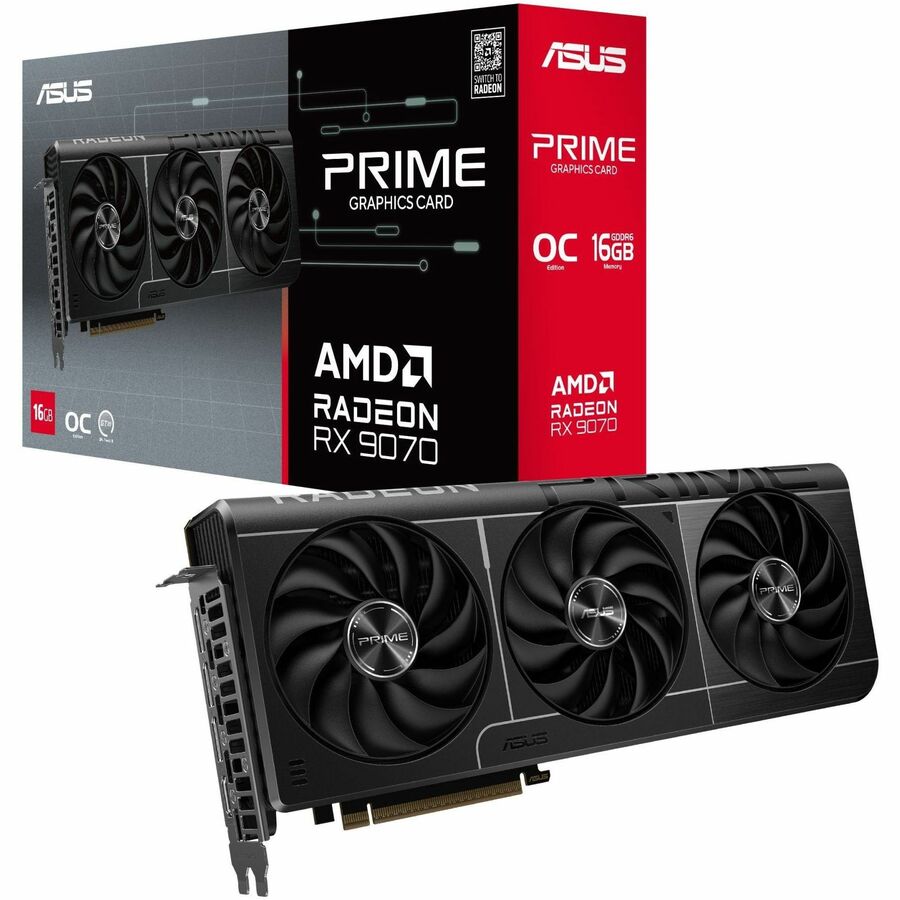
Power is the other quiet win. The 9070 is rated at 220W board power against the 5070's 250W, and in gaming GamersNexus measured about 224W versus 231W (GamersNexus) — so the faster raster card is also the cooler, quieter one in most titles. Both are comfortable on a quality 650W supply; our PSU wattage guide for RTX 50-series cards covers the math, and it applies to a 9070 build at this power level too.
Price and availability in our catalog
Prices move, so here is where the two sit in our catalog as of writing:
| RTX 5070 | RX 9070 | |
|---|---|---|
| Price (our catalog) | $916.60 | $957.72 |
| Memory | 12GB GDDR7 | 16GB GDDR6 |
| Rated board power | 250W | 220W |
| 1440p raster (vs the other) | baseline | ~13% faster |
| Heavy ray tracing | Pulls far ahead | Falls off |
| Upscaling | DLSS 4 + Multi Frame Gen, wider support | FSR 4, RDNA 4 only |
The gap is only about $41, so unlike the higher tiers this is not a "pay double for a small gain" argument — it is a straight trade of strengths. You can drop either card into a full build with automatic compatibility and power-supply checks in our PC Builder, and our best GPU for 1440p gaming roundup shows where each sits against the rest of the stack.
Who should buy which
- Buy the RX 9070 if you game at 1440p in mostly rasterized titles, want 16GB of VRAM for headroom, or care about lower power and noise. You get more frames per dollar and the more future-proof memory for essentially the same money.
- Buy the RTX 5070 if you play path-traced games, want the widest day-one upscaling support plus Multi Frame Generation, or run CUDA/NVENC creator workloads — the areas where the 9070 genuinely falls behind.
The honest version: at these prices the RX 9070 is the default 1440p pick for most players, and the 5070's 12GB VRAM is the one spec that could age it early. But if ray tracing is why you are upgrading, the raster average is the wrong number to shop by — the 5070's RT lead is exactly the thing a spec-sheet glance misses. If you want the step-up fight one tier higher, our RTX 5070 Ti vs RX 9070 XT breakdown covers the same trade at more frames and more money.