
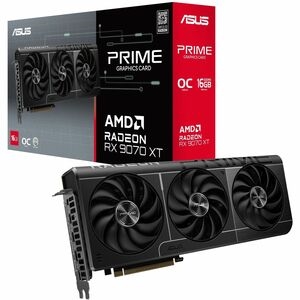
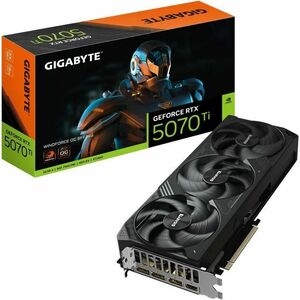
If you game at 1440p and mostly leave ray tracing off, buy the RX 9070 XT. It trades blows with the RTX 5070 Ti in traditional rasterized rendering — a coin toss at 1440p, where a 52-game average put it about 1% ahead (TechSpot) — while costing about $266 less in our catalog. Buy the RTX 5070 Ti instead if you turn on ray tracing (especially path tracing), lean on upscaling, or care about power draw and heat, because it is meaningfully ahead in all three. At native 4K raster the 5070 Ti holds a small, consistent lead of roughly 4–5%; everywhere else in rasterization these two are close enough that price and features decide it, not frames.
That is the honest version of a matchup the marketing muddies. AMD launched the 9070 XT at $599 to sit right under the 5070 Ti's $749, and in pure raster it landed there (GamersNexus). The gap that remains is not about how many frames each card pushes in a standard render — it is about what happens when you switch on the heavy features, and about how much power the card burns getting there.
Raster performance: effectively a tie
In standard rasterized rendering — no ray tracing, native resolution — these cards are close enough that the winner changes from game to game. Across a 52-game suite tested on a high-end CPU, TechSpot found the 9070 XT roughly 1% ahead at 1440p and the 5070 Ti about 4–5% ahead once results were blended toward 4K (TechSpot). A single-percent average is a rounding error: in practice you will not feel it, and a driver update later pushed the 9070 XT to edge ahead at 1440p outright (TechPowerUp).
The per-game swings are larger than the average suggests, and they cut both ways. Testing on a Ryzen 9 7950X3D bench, Club386 saw the 5070 Ti lead Final Fantasy XIV by about 10% at 1440p and 17% at 4K, while Assassin's Creed Mirage favored the 9070 XT across resolutions (Club386). That is the pattern: engine and title decide each individual result, and neither card sweeps. If raster is all you run, you are choosing between two cards that deliver the same experience — so let price and the features below break the tie.
Ray tracing: where the gap opens
Turn on ray tracing and the two cards stop being interchangeable. How far they separate depends entirely on how heavy the RT workload is. In lighter and moderate implementations the gap is small — GamersNexus measured near-parity in Resident Evil 4, about 3.6% in Dragon's Dogma 2 at 4K, and roughly 10% in Cyberpunk 2077 at 4K on the medium RT preset (GamersNexus). At that level, the 9070 XT keeps up fine.
The picture inverts under a full path-traced load. In Black Myth: Wukong with path tracing, GamersNexus recorded the 5070 Ti at roughly 53% faster at 1080p, about 66% faster at 1440p, and around 78% faster at 4K (GamersNexus). Club386 saw a similar split in heavy RT, with the 5070 Ti about 46% ahead in Cyberpunk 2077 at 1440p with ray tracing and no upscaling (Club386). This is the honest downside of the AMD card: RDNA 4 narrowed AMD's ray tracing deficit, but in the most demanding path-traced titles the 9070 XT still falls off a cliff the 5070 Ti does not.
So the RT question is really about which games you play. Screen-space and light hybrid RT? The cards are close. Path tracing in Cyberpunk, Wukong, or Alan Wake 2? The 5070 Ti is in a different class, and no price argument closes a 50–78% gap.
Upscaling: DLSS's reach vs FSR 4's leap
Upscaling is now part of how these cards are actually used, and it is a real point of separation. FSR 4, exclusive to RDNA 4, was a genuine leap for AMD — reviewers credit it with closing most of the image-quality gap that made older FSR versions a liability (TechSpot). If your games support it, the 9070 XT is no longer giving up much on picture quality.
The catch is coverage. DLSS ships in far more titles than FSR, and on the RTX 50 series it adds Multi Frame Generation, which the 9070 XT has no direct equivalent to (Club386). For a brand-new game, DLSS is likelier to be present on day one. This is not a knockout — plenty of games support both — but if you play a wide, current library and rely on upscaling to hit high frame rates, Nvidia's ecosystem is still the safer bet.
Power draw and heat
The 5070 Ti wins efficiency clearly. GamersNexus measured it pulling roughly 209–266W across a range of games, while the 9070 XT sat near 310W under gaming load, above its 304W rated board power (GamersNexus). That is 40–100W more heat dumped into your case for the same raster frames.
In practice that means the 9070 XT wants a little more airflow and a slightly larger power-supply margin. Neither card is exotic to power — both are comfortable on a quality 750W unit — but if your build is thermally tight or your PSU is already near its limit, the cooler, lower-draw 5070 Ti is the easier card to live with. If you are sizing a supply from scratch, our PSU wattage guide for RTX 50-series cards covers the math, and it applies just as well to a 9070 XT build at this power level.
Price and availability in our catalog
Prices move, so here is where these two sit in our catalog as of writing:
| RTX 5070 Ti | RX 9070 XT | |
|---|---|---|
| Price (our catalog) | $1,311.87 | $1,045.60 |
| Memory | 16GB GDDR7 | 16GB GDDR6 |
| Rated board power | 300W | 304W |
| Measured gaming power | ~210–266W | ~310W |
| Ray tracing | Class-leading in path tracing | Close in light RT, far behind in path tracing |
| MSRP | $749 | $599 |
The catalog gap — about $266, or 20% — is wider than the $150 MSRP difference, and that matters to the decision. For near-identical raster, the 9070 XT is the cheaper path to the same frames. What you give up for those savings is not raster performance; it is ray tracing headroom, upscaling coverage, and efficiency. You can drop either card into a full build with automatic compatibility and power-supply checks in our PC Builder, or read our best GPU for 1440p gaming roundup to see where this tier sits against the rest.
Who should buy which
- Buy the RX 9070 XT if you game primarily at 1440p in rasterized titles, keep ray tracing off or light, and want to save about $266 for essentially the same frame rates. That saving is real money better spent on a faster CPU, more storage, or a better monitor.
- Buy the RTX 5070 Ti if you play path-traced games, rely on upscaling across a broad current library, or want the cooler, more efficient card — and the roughly $266 premium in our catalog is acceptable for those wins.
The honest caveat cuts against the 5070 Ti for one specific buyer: if you game at 1440p with ray tracing off, you are paying about $266 more for a card that is, on average, no faster than the 9070 XT — sometimes slightly slower. The premium there buys RT and DLSS headroom you may never use. Conversely, the 9070 XT's price advantage evaporates the moment path tracing enters the picture, where being 50–78% slower is not something $266 makes up for. Match the card to how you actually play, not to which logo wins the spec-sheet argument. If you are weighing the two AMD cards instead, our RX 9070 vs RX 9070 XT breakdown runs the same math one tier down.