
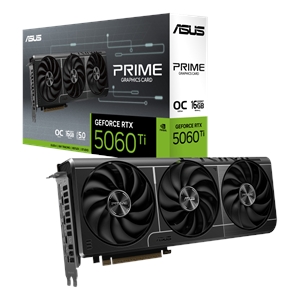
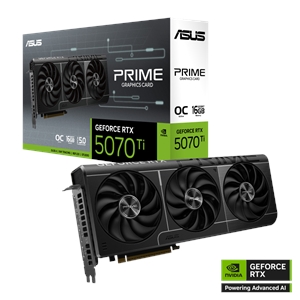
Buy the RTX 5070 Ti if you game at 1440p high-refresh or 4K: in GamersNexus's raster tests it runs roughly 55-80% faster than the RTX 5060 Ti 16GB, and in our catalog it costs about $480 more ($1,506.03 vs $1,025.78), so you pay about 47% more money for more than 50% more frames where it counts. If you play at 1080p, buy the 5060 Ti 16GB and keep the difference — the 5070 Ti's extra muscle goes to waste on a resolution the smaller card already handles.
The reason the question comes up is that both cards look similar on the box. Both are RTX 50-series (Blackwell), both carry 16GB of GDDR7, and both support DLSS 4 with Multi Frame Generation. So the spec that actually separates them — raw shader and memory-bus throughput — is the one buyers tend to skip past.
1440p gaming performance
This is where the two cards split, so it is the number that should decide the purchase. The figures below are average fps from GamersNexus, measured in raster (no ray tracing) at 1440p on their test bench. The 5070 Ti numbers come from their February 2025 review; the 5060 Ti 16GB numbers from their April 2025 review, same games and settings.
| Game (1440p, raster) | RTX 5060 Ti 16GB | RTX 5070 Ti | 5070 Ti lead |
|---|---|---|---|
| Final Fantasy XIV: Dawntrail (Maximum) | 104 fps | 187 fps | +80% |
| Starfield (Ultra) | 65 fps | 101 fps | +55% |
| Black Myth: Wukong (High, no RT) | 57 fps | 87 fps | +53% |
The spread is wide because the gap grows as a game gets more GPU-bound. In the lighter FFXIV engine the 5070 Ti stretches to an 80% lead; in the heavier Wukong and Starfield it settles around 53-55%. Either way, the 5060 Ti 16GB stays above 55 fps in all three — playable, but you feel the difference the moment you aim for a 120 Hz+ panel.
The specs behind the gap
Marketing puts "16GB GDDR7" on both boxes, which is true and also the least useful number for choosing between them. The two cards share memory capacity and differ on everything that feeds it.
| RTX 5060 Ti 16GB | RTX 5070 Ti | |
|---|---|---|
| CUDA cores | 4,608 | 8,960 |
| Memory | 16GB GDDR7 | 16GB GDDR7 |
| Memory bus | 128-bit | 256-bit |
| Total graphics power | 180W | 300W |
| Min. system power (NVIDIA) | 600W | 750W |
| Our price | $1,025.78 | $1,506.03 |
The 5070 Ti has roughly double the shader cores and double the memory bus width, which is why its lead tracks the game's GPU load almost linearly. The shared 16GB matters for a different reason: neither card is the one to worry about running out of VRAM at 1440p, so "buy the 5070 Ti for the memory" is not a real argument. If 8GB vs 16GB is the question on your mind, that is a separate decision inside the 5060 Ti line — see RTX 5060 Ti 8GB vs 16GB.
Ray tracing and 1080p: where each lands
Ray tracing widens the gap. The 5070 Ti carries about double the RT cores (70 vs 36), and RT-heavy titles lean on exactly the throughput the 5060 Ti is short on. In GamersNexus's testing the 5060 Ti 16GB drops to 50 fps in Cyberpunk 2077: Phantom Liberty at 1080p with RT Ultra — at 1080p, not 1440p. If path tracing and RT Ultra are on your must-have list, the 5060 Ti starts needing DLSS to stay smooth while the 5070 Ti has native headroom.
The flip side is 1080p raster, where the 5070 Ti is the wrong buy. GamersNexus measured the 5060 Ti 16GB at 160 fps in FFXIV, 82 fps in Starfield and 81 fps in Black Myth: Wukong at 1080p. Those are already above 60 fps, and on a 1080p panel the 5070 Ti's extra frames either exceed your refresh rate or run into the CPU before the GPU. You would be paying 47% more for performance your display can't show. For a 1080p build, put the saved $480 toward a faster CPU or a 1440p monitor instead.
DLSS 4 with Multi Frame Generation runs on both cards, so upscaling and frame generation are not a tiebreaker — they lift both by a similar margin.
Price and power in our catalog
In our catalog the RTX 5060 Ti 16GB is $1,025.78 and the RTX 5070 Ti is $1,506.03 — a $480 step up, about 47% more. Weighed against a 55-80% performance gain at 1440p, the 5070 Ti is the stronger value per frame if you game at that resolution or higher. Below it, the math inverts and the 5060 Ti wins on cost per usable frame.
Factor the power supply into the step up. The 5070 Ti's 300W draw and NVIDIA's 750W system-power minimum mean a 550-650W unit that was fine for a 5060 Ti build will need replacing. Drop either card into our PC Builder to check PSU headroom and case clearance before you commit.
Who should buy which
- Buy the RTX 5060 Ti 16GB if you game at 1080p or entry-level 1440p, run light-to-moderate ray tracing, and want to keep the build cost and the PSU requirement down. It clears 60 fps in most raster titles at 1440p and comfortably exceeds it at 1080p.
- Buy the RTX 5070 Ti if you game at 1440p high-refresh or 4K, or you lean on ray tracing. The ~47% premium buys 55-80% more frames where you'll actually see them, and it has the RT headroom the 5060 Ti lacks. For how it holds up a tier higher, see the RTX 5070 Ti at 4K.
Still deciding on a resolution first? How much VRAM you need for gaming and our best GPU for 1440p gaming in 2026 rundown both feed into this choice.