
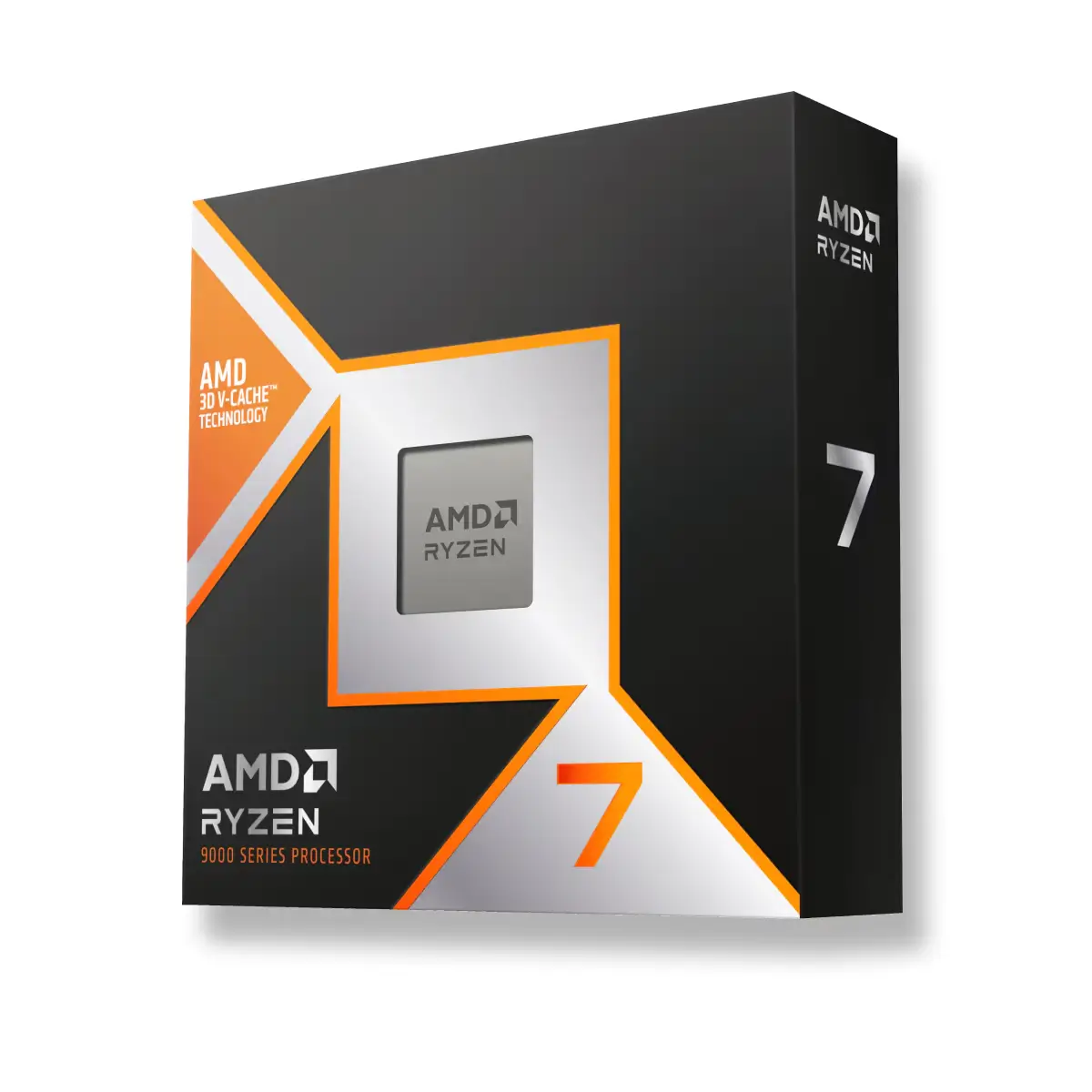
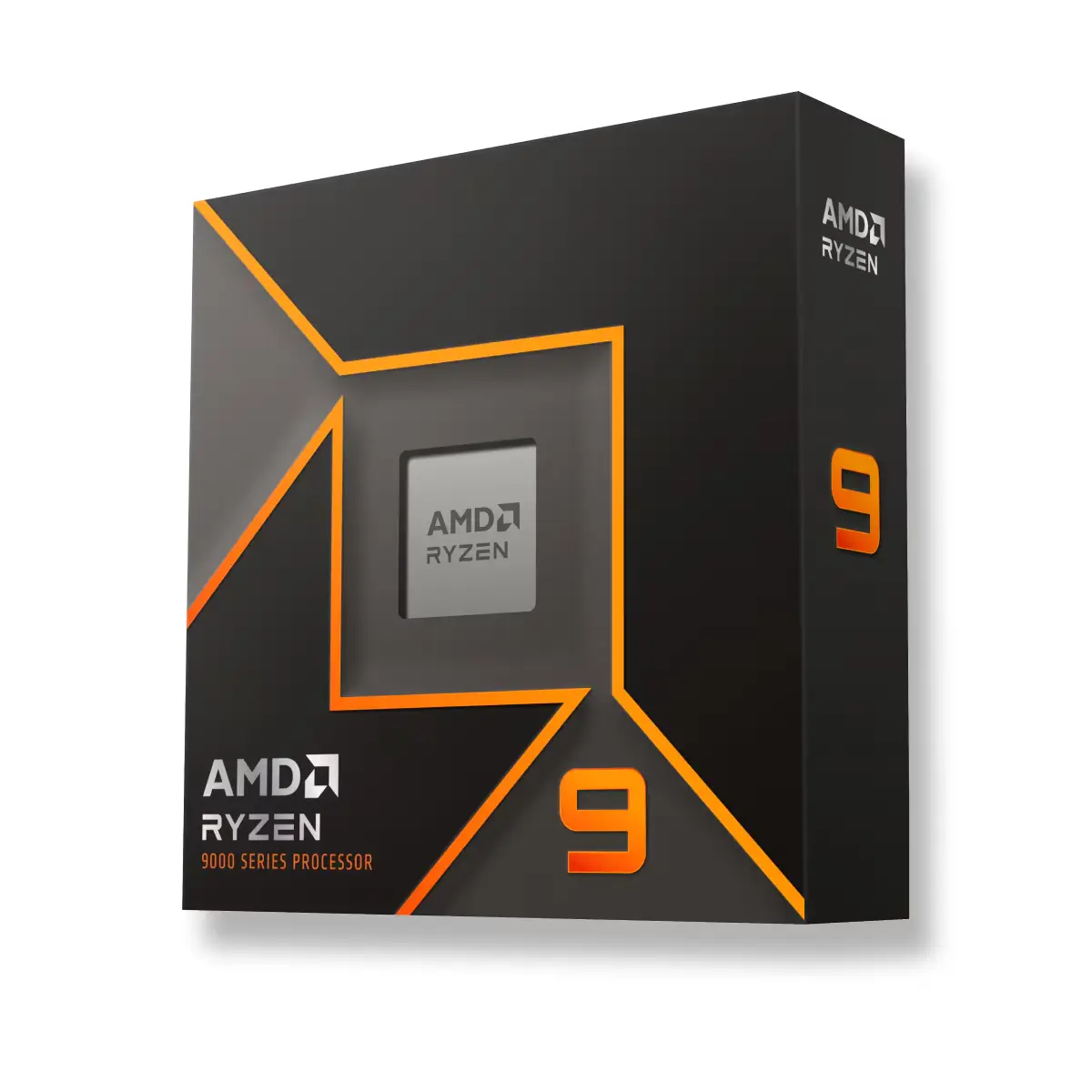
For a pure gaming PC, buy the Ryzen 7 9800X3D — its stacked 3D V-Cache makes it faster in games than the Ryzen 9 9950X despite having half the cores, and it costs less. For heavy multi-threaded work — rendering, video exports, code compiles — the 9950X's 16 cores pull far ahead. They run on the same AM5 board, so the choice is not about which chip is "better"; it is about whether your bottleneck is frames or throughput.
The question comes up because the 9950X looks like the stronger chip on every spec that fits on a box: double the cores, a higher boost clock, a bigger price tag. So people assume it must also be the better gaming CPU. It isn't — and that gap between the spec sheet and the frame counter is the whole reason this comparison exists.
Gaming performance: the 9800X3D wins on cache
Games are mostly latency-bound, not core-hungry. Most titles lean on a handful of threads and spend their time waiting on memory, so the processor that keeps data closest to the cores wins. That is exactly what 3D V-Cache does: the Ryzen 7 9800X3D stacks 64 MB of extra L3 on top of the die for 96 MB total, so a game's working set stays on-chip instead of making the slow trip to RAM.
The result shows up in GamersNexus's 1080p CPU benchmarks — run at low resolution on purpose, so the graphics card stops being the limit and the CPU is what you measure. In Starfield at 1080p Low, the 9800X3D hit 165 FPS AVG while the 16-core 9950X managed 124 FPS AVG. In Baldur's Gate 3 at 1080p Medium, the 9950X sat at 101 FPS AVG, with the X3D chips running well clear of it. The pattern is consistent: the cheaper, 8-core part is the faster gaming CPU.
One honest caveat on those numbers: they are 1080p figures chosen to expose the CPU. Move to 4K with a mid-range GPU and your graphics card becomes the bottleneck in most games, so the gap between these two narrows — sometimes to nothing. The 9800X3D's lead is real, but it is largest for high-refresh players at 1080p or 1440p, not for someone capping out at 60 FPS in 4K.
Productivity: where the 9950X's 16 cores pull away
Flip the workload to anything that feeds all your cores at once and the picture inverts. The Ryzen 9 9950X has 16 cores and 32 threads to the 9800X3D's 8 and 16, and in rendering that difference is close to linear. In Cinebench 2024's multi-core test — a Cinema 4D render workload — the 9950X lands around 2,293 points versus roughly 1,358 for the 9800X3D. That is about 69% more work per run, and it tracks the 2:1 core ratio almost exactly. (Those two figures come from different test benches, so treat the margin as directional, not a stopwatch.)
Puget Systems makes the mechanism explicit: Blender and V-Ray "scale well with core count and do not utilize the additional cache." The 9800X3D's headline feature does nothing for them, so the 9950X wins by the full margin its core count buys. If your day is Blender, DaVinci Resolve exports, Handbrake, or compiling large projects, the 9950X finishes meaningfully sooner.
Here is the nuance most comparisons skip: not all "productivity" is multi-threaded. Puget found the 9800X3D slightly ahead of every other Ryzen chip — the 9950X included — in Photoshop, and the top Ryzen performer in Lightroom Classic. Those apps lean on a few fast threads and low latency, right where the cache helps. So if your workstation work is photo editing rather than video rendering, the extra 8 cores sit idle and you would be paying for throughput you never use.
| Ryzen 7 9800X3D | Ryzen 9 9950X | |
|---|---|---|
| Cores / threads | 8 / 16 | 16 / 32 |
| L3 cache | 96 MB (64 MB 3D V-Cache) | 64 MB |
| Max boost | 5.2 GHz | 5.7 GHz |
| Rated TDP | 120W | 170W |
| Starfield 1080p Low (GamersNexus) | 165 FPS | 124 FPS |
| Cinebench 2024 multi-core | ~1,358 | ~2,293 |
| TechCortex price | $568.12 | $696.10 |
Price, power, and the platform they share
Both chips drop into the same AM5 socket and use DDR5, so the rest of the build — board, memory, cooler — is identical either way. That makes the decision cleanly about the CPU and nothing else.
Price cuts against intuition here. The 9950X costs $696.10 at TechCortex and the 9800X3D $568.12, so the chip that wins games is $128 cheaper than the chip that wins rendering. You are not paying more for better gaming; you are paying more for more cores you may or may not use.
Power is the other cost. The 9950X's 16 cores pull real wattage under load — GamersNexus logged 168W in Starfield and 204W in 7-Zip compression — so it wants a strong air cooler or a 240mm-plus AIO to hold its clocks. The 9800X3D's 120W rated TDP is easier to cool and runs quieter at the same effort. If you are weighing the cooler, I went deeper on the 16-core chip's needs in does the Ryzen 9 9950X need liquid cooling.
Who should buy which
- Buy the 9800X3D if gaming is the point of the machine — especially high-refresh play at 1080p or 1440p. It is faster in games, cheaper, and cooler, and the only thing you give up is multi-core grunt you would not miss in a game.
- Buy the 9950X if you render, encode, or compile for a living and game on the side. The 16 cores cut real time off those jobs, and in gaming the chip is still fast — it just isn't the fastest. For a mixed streaming-and-gaming box, I compare the field in the best CPU for streaming and gaming in 2026.
If you want the gaming chip but on a budget, the previous-generation Ryzen 7 9800X3D vs Ryzen 7 7800X3D breakdown shows how little you give up by stepping down, and Ryzen 7 7800X3D vs Ryzen 9 9950X runs the same cache-versus-cores question one tier lower. Either way, the PC Builder checks that your chosen chip, board, and cooler actually fit together before you buy.