
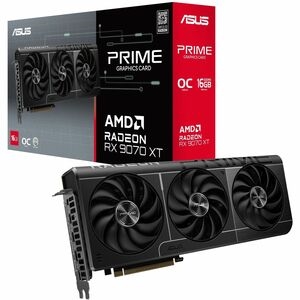
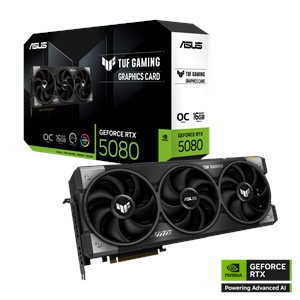
If you game at 1440p and mostly leave heavy ray tracing off, the RTX 5080 is not worth double the money — buy the RX 9070 XT. In pure rasterized rendering the 5080 leads by only about 15-20% at 4K, and less at 1440p, yet it costs roughly twice as much in our catalog ($2,117.30 versus $1,045.60). Buy the RTX 5080 instead if you play path-traced games at 4K, want the broadest upscaling and frame-generation support, or run creator workloads that lean on CUDA and NVENC — because in those specific scenarios it pulls far enough ahead that the price stops being the only story.
That is the honest version of a matchup the spec sheet oversells. The 5080 sits a full tier above the 9070 XT and wears a flagship-adjacent price, so you would expect a flagship-sized lead. In everyday rasterized games you do not get one. Where you do get a real gap is the moment you turn on the demanding features — path tracing especially — and that gap, not the raster average, is what your $1,072 is actually buying.
Raster performance: a real lead, not a flagship lead
No single review benchmarks these two head-to-head across a large suite, because they launched a tier and a price bracket apart. So the raster picture is a composite of two well-tested relationships. First, the 9070 XT is effectively a 5070 Ti in rasterized games: across titles like F1, Cyberpunk, Resident Evil 4 and Dragon's Dogma 2, GamersNexus found the two "within 6% of each other (on either side)" at 4K, with the 5070 Ti marginally ahead in most (GamersNexus). A separate 52-game TechSpot average put the 9070 XT about 1% ahead at 1440p and the 5070 Ti about 4-5% ahead at 4K (TechSpot). Call it a tie.
Second, the 5080 sits one step above the 5070 Ti — but a smaller step than the price implies. In real games at 4K, TechSpot measured the 5070 Ti trailing the 5080 by about 11-13% in titles like Marvel Rivals and A Plague Tale: Requiem (TechSpot); synthetic 3DMark runs put the gap near 17% (Tom's Hardware). Stack the two relationships and the 5080's rasterized lead over the 9070 XT lands around 15-20% at 4K, and shrinks at 1440p where the 9070 XT is at its strongest. That is a lead you can measure but rarely feel in a single-player game — the difference between, say, 90 and 105 fps. It is not the 2x separation the price tag suggests.
Ray tracing: where the money goes
Turn on ray tracing and the two cards stop being comparable — but only when the RT load is heavy. In light and moderate implementations the 9070 XT holds up: GamersNexus measured it within about 3.6% of the 5070 Ti in Dragon's Dogma 2 at 4K and roughly 10% behind in Cyberpunk 2077 on the medium RT preset (GamersNexus). Since the 5080 is only ~11-17% up on the 5070 Ti, the 9070 XT stays in the same conversation for that kind of hybrid RT.
Full path tracing is a different sport. In Black Myth: Wukong with path tracing, GamersNexus recorded the 5070 Ti about 53% faster at 1080p, 66% faster at 1440p and 78% faster at 4K than the 9070 XT (GamersNexus). The 5080 clears that bar by a further tier — its ray tracing lead over AMD's previous flagship, the RX 7900 XTX, was about 57% (KitGuru). Against the 9070 XT in Cyberpunk or Wukong path tracing, the 5080 is effectively playing a different game: it can roughly double the frame rate. This is the honest core of the decision. If your library runs path tracing, no price argument closes that gap. If it does not, you are paying for headroom you will not touch.
Upscaling and features: DLSS 4 vs FSR 4
Upscaling is now part of how both cards are actually used, and it favors the 5080 on coverage rather than quality. FSR 4, exclusive to RDNA 4 and therefore present on the 9070 XT, was a genuine leap for AMD — reviewers credit it with closing most of the image-quality gap that made older FSR a liability (TechSpot). Where you actually play, the 9070 XT is no longer giving up much picture quality when upscaling is on.
The 5080's edge is reach. DLSS ships in far more titles than FSR, and the RTX 50 series adds Multi Frame Generation, which the 9070 XT has no direct equivalent to. For a brand-new game, DLSS is likelier to be there on day one. If you buy new releases at launch and lean on upscaling to hit high refresh, that ecosystem breadth is a real, if situational, reason to pay more.
Power and PSU
Here the flagship intuition breaks down in the 9070 XT's favor on absolute draw, and the 5080's favor on efficiency. The 5080 measured about 297W across a 4K game suite against its 360W rated board power (KitGuru), while the 9070 XT sat near 310W under gaming load, slightly above its 304W rating (GamersNexus). They land within roughly 15W of each other, so the 5080 does not add meaningful heat to your case — it delivers more frames for about the same wattage, which makes it the more efficient card per frame even though it is not the low-power one. Both are comfortable on a quality 850W supply. If you are sizing one from scratch, our PSU wattage guide for RTX 50-series cards covers the math, and it applies to a 9070 XT build at this power level too.
Price and availability in our catalog
Prices move, so here is where the two sit in our catalog as of writing:
| RTX 5080 | RX 9070 XT | |
|---|---|---|
| Price (our catalog) | $2,117.30 | $1,045.60 |
| Memory | 16GB GDDR7 | 16GB GDDR6 |
| Rated board power | 360W | 304W |
| Measured 4K gaming power | ~297W | ~310W |
| 4K raster (vs the other) | ~15-20% faster | baseline |
| Path tracing | Roughly double the frame rate | Falls off in heavy RT |
The catalog gap is about $1,072 — the 5080 costs roughly twice the 9070 XT. For rasterized gaming that money buys a ~15-20% frame-rate bump at 4K and nothing extra in VRAM. What it also buys, and what actually justifies it for the right buyer, is path-tracing performance in a class the 9070 XT cannot reach, plus DLSS 4 and Multi Frame Generation coverage. You can drop either card into a full build with automatic compatibility and power-supply checks in our PC Builder, and our best GPU for 1440p gaming roundup shows where each sits against the rest of the stack.
Who should buy which
- Buy the RX 9070 XT if you game at 1440p or do 4K rasterized gaming with ray tracing off or light. You get essentially 5070 Ti-class frames for about half the 5080's price, and the roughly $1,072 you keep is better spent on a faster CPU, more storage, or a higher-refresh monitor.
- Buy the RTX 5080 if you play path-traced games at 4K, want the widest upscaling and frame-generation support across a current library, or run creator apps that use CUDA and NVENC — and the ~2x premium is acceptable for wins the 9070 XT genuinely cannot match.
The honest caveat cuts hard against the 5080 for one buyer: if you game at 1440p in rasterized titles, you are paying about double for a card roughly 15-20% faster than one you already find fast — a premium for path-tracing and feature headroom you may never use. And it cuts against the 9070 XT for the opposite buyer: the moment path tracing enters your rotation, being half the price does not make up for running at half the frame rate. Match the card to how you actually play, not to which one wins the spec-sheet argument. If you want the closer, cheaper fight, our RTX 5070 Ti vs RX 9070 XT breakdown and our RTX 5070 Ti vs RTX 5080 comparison bracket this matchup on both sides.