
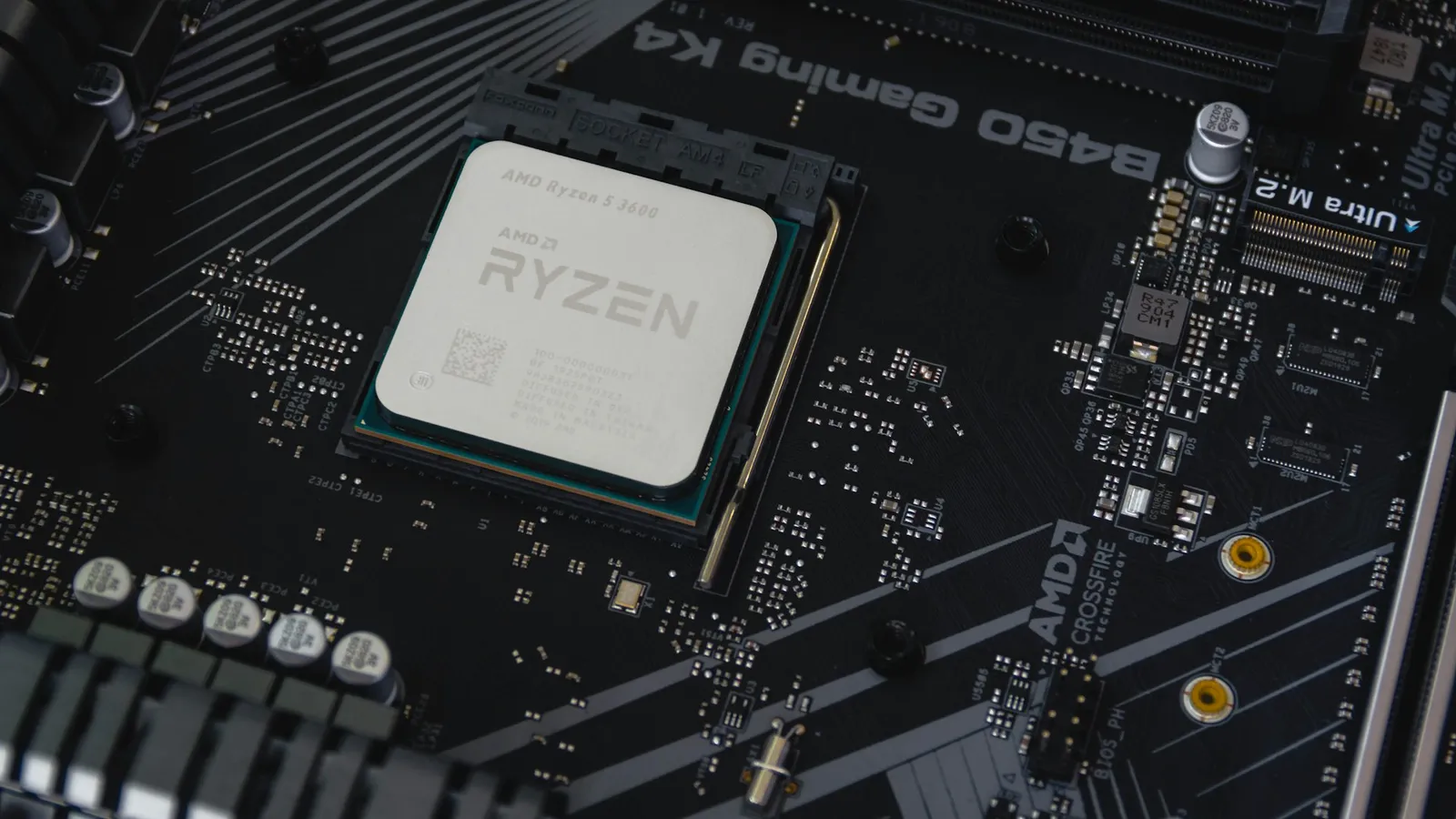
For a PC that only plays games, the six-core Ryzen 5 7600X ($203.27) is enough, and the Ryzen 7 7700X ($279.99) is not worth its extra $77. The 7700X is about 3% faster on average at 1080p and no faster once you move to 1440p, where the graphics card sets the pace (TechSpot). The eight-core chip earns its money the moment you stop gaming — streaming, video exports, compiles, and heavy multitasking — not in your frame counter.
The confusion comes from the spec sheet. Eight cores looks like a straight upgrade over six, and for some workloads it is. But games rarely saturate six modern Zen 4 cores, so the 7700X's two extra cores mostly sit idle while you play. What you are really choosing between is a cheaper gaming chip and a slightly better all-rounder.
Gaming performance: six cores rarely runs out of room
Games lean on a few fast cores and a large cache far more than on core count. Both chips carry the same 32 MB L3 cache on a single Zen 4 die, and both clock within 0.1 GHz of each other — the 7600X boosts to 5.3 GHz, the 7700X to 5.4 GHz. That is why the frame-rate gap is small: in the parts of the workload that matter for games, these chips are nearly identical.
TechSpot measured the 7700X about 3% faster on average across its game suite at 1080p with a fast GPU. The spread matters more than the average. Most titles were within one or two frames; a few thread-heavy games stretched the lead to around 10%, with Watch Dogs: Legion the clearest example. So the honest read is not "eight cores is faster" — it is "eight cores is a little faster in the minority of games that can use them, and the same everywhere else."
That already-small lead shrinks to nothing as you raise the resolution. At 1440p and 4K the graphics card becomes the ceiling, both CPUs feed it the same frames, and they land within margin of error. If you game at 1440p — most people building around this class of chip do — the choice between them changes your frame rate by roughly zero.
| Ryzen 5 7600X | Ryzen 7 7700X | |
|---|---|---|
| Cores / threads | 6 / 12 | 8 / 16 |
| Max boost clock | 5.3 GHz | 5.4 GHz |
| L3 cache | 32 MB | 32 MB |
| TDP | 105 W | 105 W |
| Bundled cooler | None | None |
| Price (TechCortex) | $203.27 | $279.99 |
Where the 7700X pulls ahead: everything threaded
The two extra cores are real performance — just not in games. In workloads that scale across every thread, the 7700X is roughly 30% faster: its ~20,000 Cinebench R23 multi-core score against the 7600X's ~15,100 (KitGuru). Video encodes, code compiles, 3D renders, photo batch edits, and running a dozen browser tabs while a game loads all pull on those cores.
The one gaming-adjacent case where eight cores clearly helps is streaming or recording while you play. If OBS is encoding on the CPU at the same time your game is running, the 7600X's six cores get contested and 1% lows can dip; the 7700X has the headroom to do both without the game feeling it. If you never stream and never render, that headroom is money spent on capacity you will not use.
Same platform, so it is a clean CPU-only call
Both chips drop into the same Socket AM5 motherboard, run the same DDR5, and use the same cooler, so the rest of the build costs the same either way (Tom's Hardware). One catch that trips up first-time builders: neither X-chip includes a cooler in the box, so budget for an air tower or AIO on top of the CPU price.
There is also a third option worth naming. If gaming is genuinely the only job and you can stretch the budget, the Ryzen 7 7800X3D ($409.99) is a bigger jump than the step from six to eight cores — its stacked 3D V-Cache makes it about 16% faster than the 7700X at 1080p. We break that trade down in Ryzen 7 7800X3D vs 7700X. For where a six-core chip sits in the wider lineup, see Best CPU for 1440p Gaming in 2026. When you are ready to spec the whole system with compatibility checked automatically, build it in our PC Builder.
Who should buy which
- Buy the Ryzen 5 7600X if the PC is for gaming, especially at 1440p, and you want to put every saved dollar into the graphics card. Six cores comfortably handle modern games, and it is the better value of the two.
- Buy the Ryzen 7 7700X if you stream or record while gaming, or the machine also renders, compiles, or multitasks hard. The extra $77 buys about 30% more threaded throughput and smoother streaming — not more frames in a solo game.