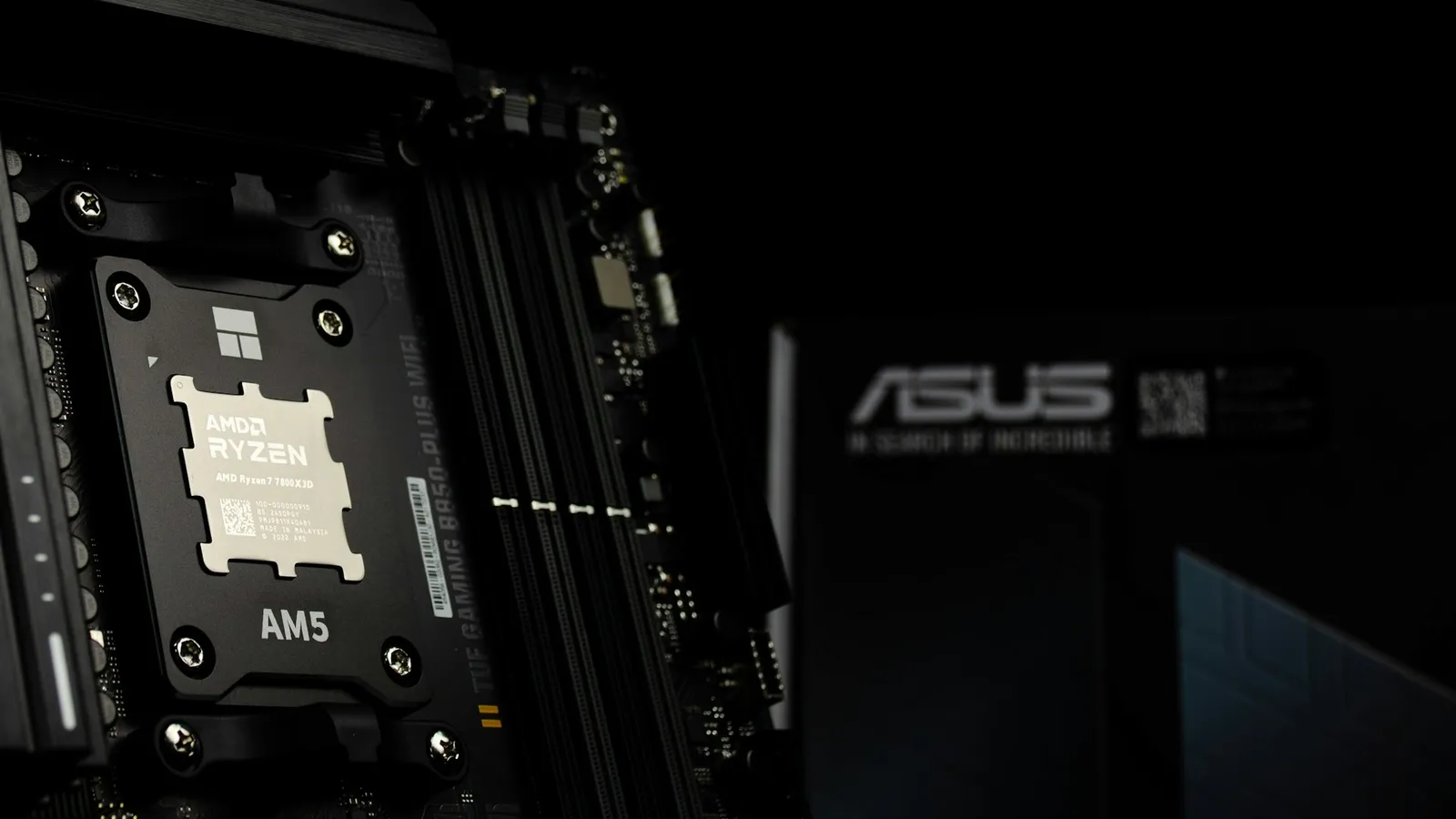


For gaming, the Ryzen 7 9800X3D wins, and it isn't close. Across a 16-game suite at 1080p, Tom's Hardware measured the 9800X3D at a 195.5 FPS average versus roughly 145 FPS for the higher-clocked Core Ultra 9 285K — about 35% faster, with 1% lows of 134 FPS against 107. The chip we stock, the locked 65W Core Ultra 9 285, runs a step behind its K-series sibling, so in games the gap is at least that wide. It is also the cheaper chip: $568.12 for the Ryzen 7 9800X3D against $757.26 for the Core Ultra 9 285.
So why is this even a question? Because the 285 looks like the bigger processor on paper. It carries 24 cores to the 9800X3D's eight, and in heavy multi-threaded work it pulls far ahead. Games just don't care. They care about memory latency and cache, and that is exactly where AMD's 3D V-Cache rewrites the math.
Gaming performance: the 3D V-Cache gap
The 9800X3D stacks 64MB of 3D V-Cache on top of its die for 96MB of L3 total. The Core Ultra 9 285 has 36MB. That cache lets the CPU keep game data close instead of waiting on system memory, and in CPU-bound titles it is worth more than a dozen extra cores.
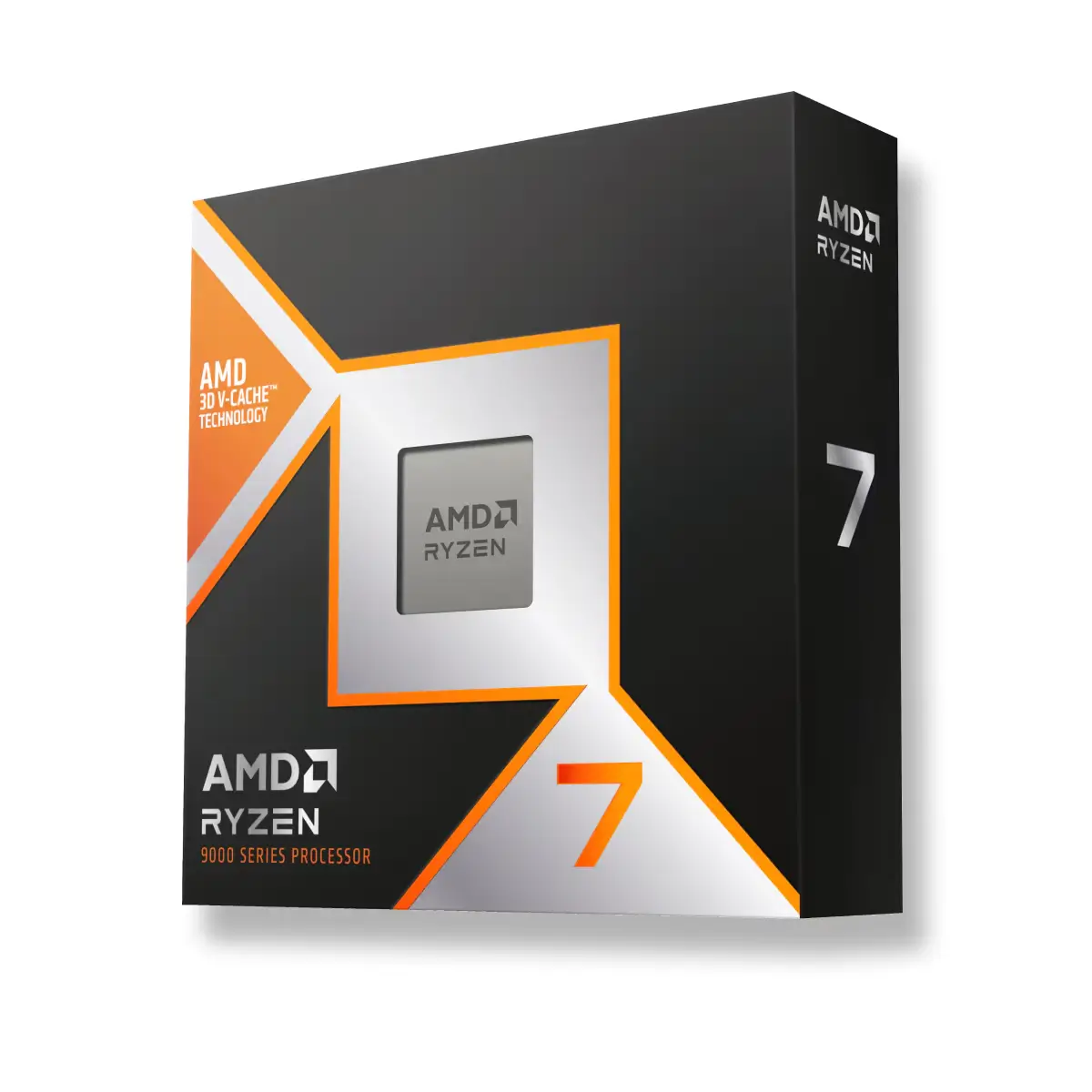
The numbers back it up. In Tom's Hardware's 1080p testing — the resolution that isolates the CPU — the 9800X3D led by about 35% on average and held much stronger 1% lows (134 vs 107 FPS), which is what you feel as smoothness rather than a number on a graph. Reviewers using different game sets report smaller but same-direction gaps: a 12-game geometric mean still put the 9800X3D around 22% ahead at 1080p.
One honest caveat: the 285 we carry is the locked, 65-watt version of Arrow Lake, while almost every gaming benchmark online is run on the unlocked 285K. The 285 boosts to 5.6 GHz instead of 5.7 and runs tighter power limits, so its gaming numbers land slightly below the 285K's — never above. Nothing about the locked part closes the gap with the 9800X3D.
| Ryzen 7 9800X3D | Core Ultra 9 285 | |
|---|---|---|
| Cores / threads | 8 / 16 | 24 / 24 |
| L3 cache | 96 MB | 36 MB |
| Max boost | 5.2 GHz | 5.6 GHz |
| Base power | 120 W | 65 W |
| Socket / platform | AM5 | LGA1851 |
| Catalog price | $568.12 | $757.26 |
Where the Core Ultra 9 285 earns its price
This is the part the 9800X3D cannot answer. Twenty-four cores is a lot of throughput, and if your day involves Blender renders, code compiles, video exports, or running a heavy virtual machine while you work, the 285 finishes those jobs far faster. In Cinebench 2024 multi-threaded, the 285K scored 2496 to the 9800X3D's 1376 — roughly 80% more work per run.
The locked 285 we sell gives up some of that lead to the 285K, but not the character of it. It is a 65-watt base-power chip that, according to Wccftech, trades blows with the old Core i9-14900K in multi-threaded tests while drawing far less power. If your priority is rendering or compiling at low heat and noise, that is a genuinely good buy — it is simply not a gaming argument.
Price and platform
At today's catalog prices the 285 is the more expensive chip by $189, and you are paying that premium for cores a gaming PC will rarely use. Both platforms are modern — DDR5 memory, PCIe 5.0 for your GPU and SSD — so neither locks you out of current parts.
The difference is the road ahead. AMD's AM5 socket, which the 9800X3D uses, is slated for support into 2027 and beyond, so a future CPU upgrade can drop onto the same board. Intel's LGA1851 arrived with this generation and has a shorter runway. If you like the idea of a mid-life CPU swap without a new motherboard, that favors the AMD side.
You can spec either chip into a full, compatibility-checked build in our PC Builder, which flags socket and cooler mismatches before you order.
Who should buy which
- Buy the Ryzen 7 9800X3D if gaming is the point of the machine. It is faster in games, cheaper, cooler, and sits on a socket with a longer upgrade path. For most people reading this comparison, it is the answer.
- Buy the Core Ultra 9 285 if your workload is genuinely multi-threaded — rendering, encoding, compiling, heavy multitasking — and gaming is a weekend bonus. Its 24 cores do real work the eight-core AMD chip cannot match, at low power.
If you want the gaming crown and serious core count, neither of these is it — that is what AMD's X3D-equipped 12- and 16-core parts are for, at a higher price.