
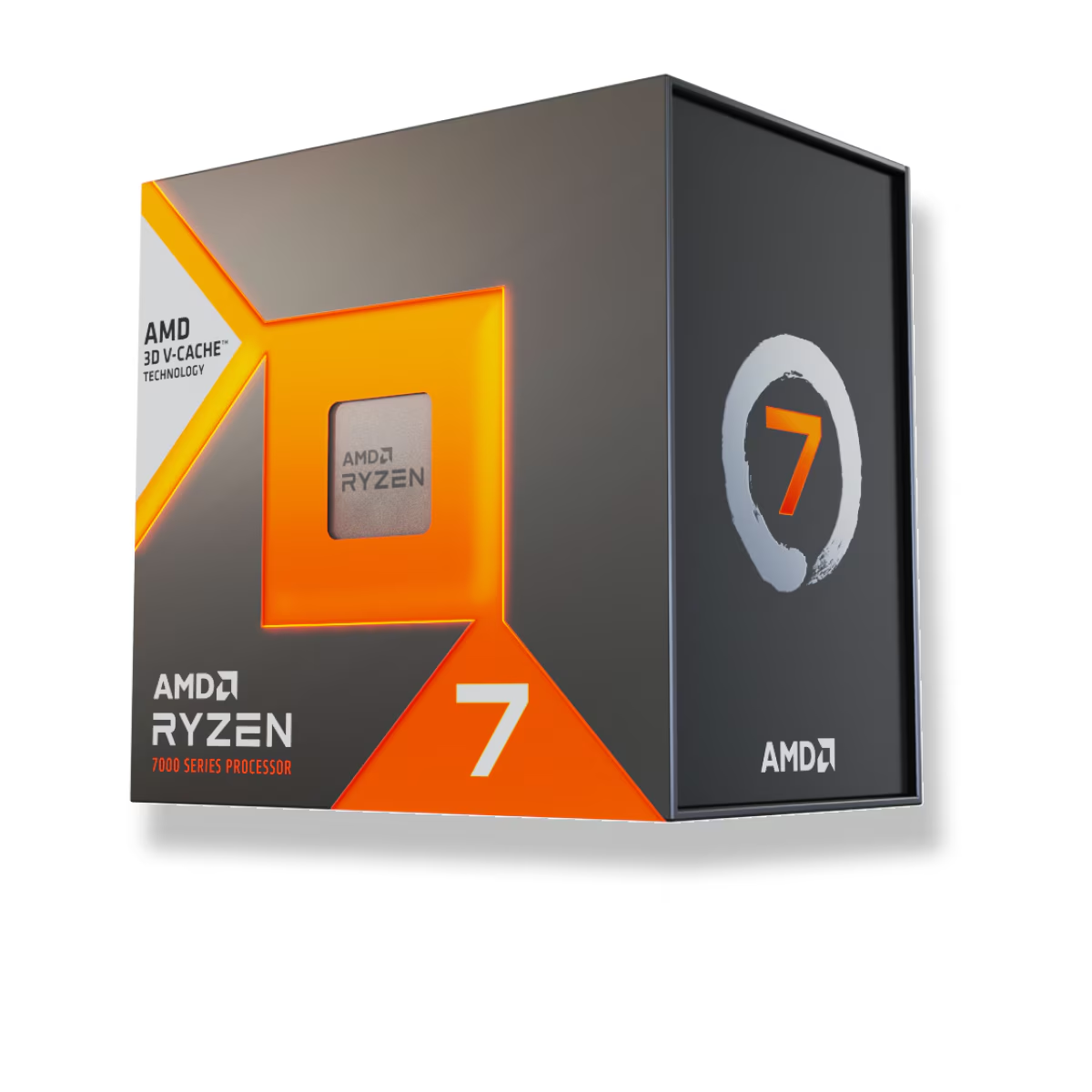
For pure gaming, buy the Ryzen 7 7800X3D. Its 96MB of stacked L3 cache makes it the faster gaming chip of the two, and in our catalog it costs $415.41 against $281.43 for the 7700X. But that $134 gap only pays off when you are actually CPU-bound: at 1080p on a fast GPU the 7800X3D averages around 13% more frames while drawing slightly less power (TechSpot). In GPU-limited games or productivity work, the cheaper, higher-clocked 7700X gives you most of the experience — and beats the X3D outright when the job is rendering, not rendering frames.
Both are 8-core, 16-thread Zen 4 chips on the same AM5 socket, so on a spec sheet they look nearly identical. The real difference is one layer of silicon — AMD's 3D V-Cache — and the marketing habit of treating it as a universal upgrade. The benchmarks show it is a targeted one.
Gaming performance at 1080p
The X3D advantage is real, but its size depends entirely on where the bottleneck sits. The numbers below come from reviews run at 1080p on an RTX 4090 — a deliberately GPU-unbottlenecked setup that exposes the CPU. Drop in a mid-range card or move to 4K and the gap shrinks toward zero, because the graphics card becomes the limit long before the processor does.
| Ryzen 7 7800X3D | Ryzen 7 7700X | |
|---|---|---|
| L3 cache | 96 MB | 32 MB |
| Boost clock | 5.0 GHz | 5.4 GHz |
| 1080p gaming (avg) | ~13% faster | baseline |
| GPU-bound titles | +0–6% | baseline |
| TDP | 120 W | 105 W |
| Catalog price | $415.41 | $281.43 |
The per-game spread is the part most "which is faster" articles skip. TheFPSReview measured the 7800X3D just 6% ahead in F1 2022, 3% in Returnal, 2% in Forspoken, and dead level with the 7700X in Call of Duty: Modern Warfare II. Those are titles that lean on the GPU or don't stress the memory subsystem, and the extra cache has little to chew on.
Why the cache helps some games and not others
3D V-Cache works by keeping game data on the chip instead of making the CPU wait on system memory. When a game constantly re-reads large data sets — physics, AI, world state — that saved trip is worth a lot. When a game is small enough to fit in a normal cache, or is waiting on the GPU anyway, the extra 64MB sits idle.
That is why the biggest wins show up in simulation, strategy, and sprawling open-world titles, and why reviewers repeatedly find the X3D's real edge in 1% lows rather than average FPS — the cache smooths out the stutters that come from memory stalls. If you run a 144Hz+ monitor and care about consistency, that matters more than the average number. If you play at 4K on a mid-tier GPU, you will struggle to see any of it.
Where the 7700X wins
The 7700X boosts to 5.4 GHz against the X3D's 5.0 GHz, and that gap is not cosmetic. The stacked cache limits the X3D's voltage and clocks, which is why it lands about 8% behind in single-core (TechSpot). In anything clock-bound — Blender, video encoding, code compilation, heavy multitasking — the 7700X is the faster chip, and GamersNexus notes the X3D consistently trails non-X3D parts in those workloads for the same reason.
It is also the more flexible chip for tinkerers. As a standard X-series part the 7700X has more thermal and clock headroom to tune, where the X3D's cache layer caps how hard you can push it. And it is $134 cheaper — money that buys a better GPU, more storage, or a nicer cooler, all of which move gaming frame rates more than a CPU swap if you are already GPU-bound.
Price and platform
Both chips drop into the same AM5 boards and both run DDR5, so the platform cost is identical either way — you are only choosing the processor. Neither includes a boxed cooler, so budget for cooling regardless of which you pick; a good air tower handles both, since the X3D's power draw is modest despite its 120W rating (Notebookcheck).
Memory is where you can quietly leave performance on the table with either chip. A tuned DDR5-6000 CL30 kit is the sweet spot for Zen 4 — see DDR5-6000 vs DDR5-8000 for why faster kits rarely pay off. You can check either CPU against a full parts list in our PC Builder, which flags socket and memory mismatches before you buy.
Who should buy which
- Buy the Ryzen 7 7800X3D if you game at 1080p or 1440p on a strong GPU, chase high refresh rates, live in simulators, strategy games, or open worlds, and want the best 1% lows money can buy in this tier.
- Buy the Ryzen 7 7700X if you are on a budget, game at 4K or on a mid-range card where you'll be GPU-bound, do real rendering, encoding, or compiling, or want overclocking headroom — and put the $134 you save toward a faster graphics card.
The honest version: if your GPU is the bottleneck, the 7800X3D is $134 for a handful of frames you will never see. If your monitor is 1080p high-refresh and your GPU is fast, it is the most obvious upgrade in the build.